All published articles of this journal are available on ScienceDirect.

Real-world Clinical Outcomes in Asthma Patients Commenced on or Switched to Dupilumab
 iD
Orlaith Shinners1
iD
Fiona Arnott1
Kevin F Deasy1 , 2
iD
Hisham Ibrahim1 , 2
Barry J Plant1 , 2
iD
Desmond M Murphy1 , 2
Authors Info & Affiliations
Abstract
Introduction
Ireland has one of the highest asthma rates globally, with an estimated 450,000 individuals diagnosed. For patients with severe asthma who remain uncontrolled despite optimal therapy, biologics targeting Type 2 inflammation, such as dupilumab, offer a promising treatment option. Dupilumab became available for reimbursement in Ireland in November 2023.
We aimed to assess the real-world effectiveness of dupilumab in adults with severe asthma, including those previously treated with other biologics.
Methods
This retrospective, single-centre study reviewed patients initiated on or switched to dupilumab between November 2023 and November 2024 at Cork University Hospital. Outcomes assessed at baseline and six months included Asthma Control Questionnaire (ACQ) scores, exacerbation frequency, and FEV1. Paired t-tests were used for statistical analysis.
Results
Among 39 patients (median age 55 years), 64.1% had prior biologic exposure. Dupilumab significantly improved ACQ scores (mean reduction -0.95, p=0.0003) and reduced exacerbations (mean reduction -2.89, p=0.0004). Improvements were consistent in biologic-naïve and biologic-experienced groups. FEV1 showed a non-significant upward trend (p=0.1553). Five patients (12.8%) discontinued therapy due to side effects or lack of efficacy.
Discussion
These findings support the real-world effectiveness of dupilumab in improving symptom control and reducing exacerbation frequency in patients with severe asthma, including those who have previously received other biologics. Dupilumab became reimbursable in Ireland in late 2023, and data from Irish populations have been limited until now.
Conclusion
Dupilumab significantly improved asthma control and reduced exacerbation rates in this real-world cohort, supporting its use in patients with severe asthma, including those switching from other biologic agents.
1. INTRODUCTION
Ireland has one of the highest rates of asthma worldwide, with current estimates suggesting that there are approximately 450,000 people with physician-diagnosed asthma [1]. In some cases, these patients continue to have uncontrolled asthma despite optimal treatment (appropriate inhaler technique and adherence), asthma education, modifiable risk factors, and non-biologic therapy; thus, a diagnosis of “severe asthma” is made. It is advised that patients with severe asthma be referred for specialist opinion and management.
Once patients have been optimized through inhaled and oral therapy, GINA guidelines recommend that patients with Type 2 Inflammation (raised blood eosinophils/ raised fraction of exhaled nitric oxide) who remain poorly controlled be considered for biologic therapy [2]. In the management of severe, refractory asthma, biological therapy that targets type 2 inflammation has transformed management.
There are several biologic agents that target airway inflammation available in Ireland. Omalizumab is a humanised anti-immunoglobulin E (IgE) antibody. Mepolizumab and reslizumab target interleukin-5 (IL-5), and benralizumab is an anti-eosinophil monoclonal antibody that binds to the alpha subunit of the IL-5 receptor.
Dupilumab is the most recent biologic agent that has become available for reimbursement in Ireland, available since November 2023. It is a monoclonal antibody that inhibits IL-4 and IL-13. These are major drivers of human type 2 inflammatory disease, including asthma.
Irish prescribing guidelines for Dupilumab state that Dupilumab will not be reimbursed if co-prescribed with another biologic agent. It must be prescribed by an approved consultant, who is required to document if the patient has previously been on another biologic agent. The patient is also required to be deemed inadequately controlled with high-dose inhaled corticosteroids plus another medicinal product for maintenance treatment. The patient must also have had two or more exacerbations requiring systemic corticosteroids in the one year before application or continuous oral corticosteroid for the six months before application2.
2. METHODS
A retrospective, single-centre review of clinical outcomes of patients commenced on Dupilumab or switched to Dupilumab from an anti-IL-5 or anti-IgE therapy in an academic, university-affiliated specialist adult asthma centre, Cork University Hospital, Ireland. This study had ethical approval from the Clinical Research Ethics Committee, University College Cork, Ireland (ECM 4 (e) 22/10/2024& ECM 3 (l) 19/11/2024). The Helsinki Declaration has been followed for involving human subjects in this study.
All patients over 18 years of age who were commenced on or switched to Dupilumab from November 2023 to November 2024 were included. These patients have a diagnosis of severe asthma and met the criteria to be prescribed Dupilumab.
The parameters assessed included Asthma Control Questionnaire (ACQ) score [3], exacerbation frequency (given that this study was completed over different time points, exacerbation frequency was calculated by doubling the frequency of exacerbations during the six months following commencement), and FEV1 at commencement and six months post-commencement of dupilumab. An exacerbation was defined as the patient requiring steroids and/or antibiotics. Exacerbations one year before commencement or switch therapy and in the six months post-commencement were recorded. Results were adjusted for different time periods. All patients continue to be monitored at the asthma clinic.
Anonymised data were analysed using Prism 10. Differences between pre- and 6 months post-commencement of dupilumab were analysed. These groups were compared using a paired t-test. A p-value ≤0.05 was considered significant.
The sample size comprised all patients who commenced on dupilumab at our single centre when reimbursement became available. Pre-study power calculation was not performed; however, this cohort size was adequate for moderate within-subject effects, with smaller subgroups likely underpowered.
3. RESULTS
39 patients met the inclusion criteria. In this cohort, the patients were commenced on or switched to dupilumab for asthma management between December 2023 and October 2024. There were meaningful clinical improvements observed, particularly in symptom control and exacerbation frequency, while lung function improvements were less pronounced. The majority of patients were female (61.5%).
Notably, 25/39 (64.1%) subjects had previously been on other biologic therapies, including mepolizumab (n=11), benralizumab (n=16), and omalizumab (n=3), or an unknown biologic agent (n=1, as the subject was enrolled in a blinded clinical trial). 14/39 (35.9%) of the cohort were biologic-naïve before dupilumab initiation.
We observed a significant improvement in ACQ scores (p=0.0003) (Fig. 1) with a mean reduction of -0.95, which exceeds the minimal clinically important difference for the ACQ [4], indicating a tangible improvement in symptom control following dupilumab initiation. those who are biologic naïve, there was also a significant improvement in ACQ (p=0.0002) and a mean reduction of -1.145 (Figs. 2 and 3). Similarly, the improvement in ACQ was significant in the cohort of patients who had previously received biologic therapy, with a mean reduction of -0.9 (Fig. 4). Given that a score of <1.5 indicates good control in asthma symptoms. At six months, 13/39 (33.3%) had achieved full control of their asthma (ACQ <1.5). Before treatment, 6/39 (15.4%) had an ACQ of <1.5. The mean ACQ pre-treatment for those who had been on biologic therapy was 2.6, and 2.4 in those who were naïve. At 6/12, the ACQ in those who had received therapy was 1.8, and 1.3 in those who were naïve to biologic therapy. However, for the overall group, the average ACQ post-therapy was 1.5, as compared to 2.5 pre-therapy, indicating that there is good overall asthma control.
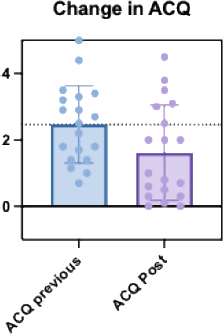
n=39; Change in ACQ one year prior to commencement and six months post commencement on dupilumab therapy (adjustment for time difference).
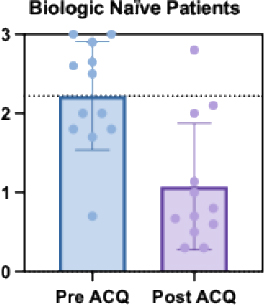
n=12.; Shows the change in ACQ in biologic naïve cohort pre and post therapy.
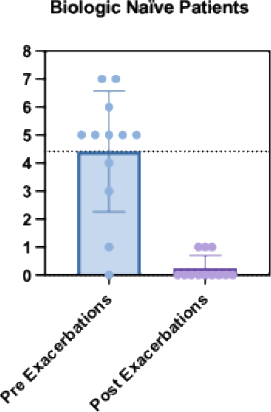
n=12. Change in exacerbation frequency in naïve cohort.
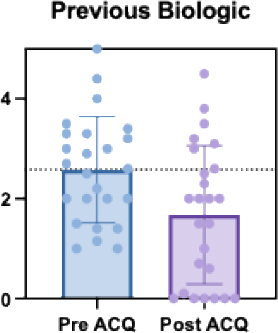
n=27. Change in ACQ in cohort with previous biologic therapy.
Additionally, exacerbation frequency significantly decreased (p=0.0004), with a mean reduction of -2.9 in exacerbation frequency (Fig. 5), supporting dupilumab’s effectiveness in reducing exacerbation burden in severe asthma management, consistent with its known steroid-sparing effects and reduction in exacerbations demonstrated previously [5-7]. The exacerbation frequencies were calculated over different time points (12 months prior and six months after commencement of treatment). As such, exacerbation frequency was calculated by doubling the frequency of exacerbation in the six months after commencement. This could be seen in the naïve group with statistical significance (p=<0.0001), with a mean difference of -4.2 (Fig. 4). This was also seen in the cohort who had previously received biologic therapy with a p-value <0.0001, and a mean difference of -2.7 (Fig. 6).
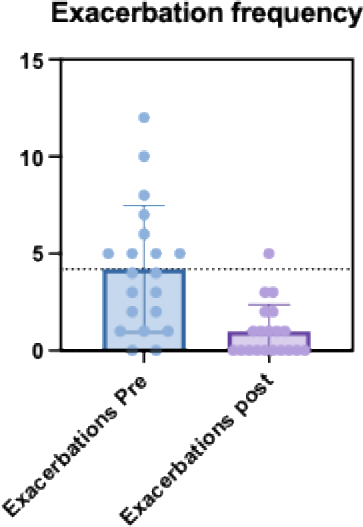
n=39. Demonstrates the change in exacerbation frequency one-year pre and six months post dupilumab commencement (adjustment for time difference).
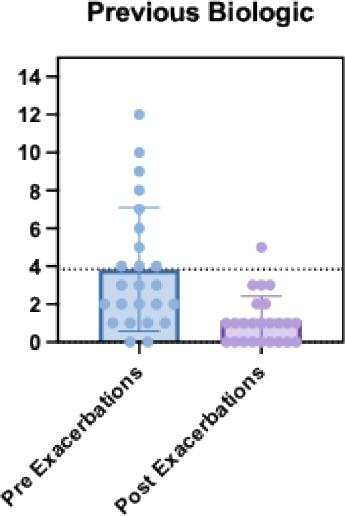
n=27. Change in exacerbation frequency in cohort with previous biologic therapy.
23/39 (59%) had spirometry completed at both pre- and post-clinic visits within the specified time period for analysis; as such, FEV1 was analysed in this smaller subgroup. Interestingly, no statistically significant improvement in FEV1 was observed (p=0.1553), despite a positive numerical trend (Figs. 7 and 8). However, given the numbers, this data should be cautiously interpreted.
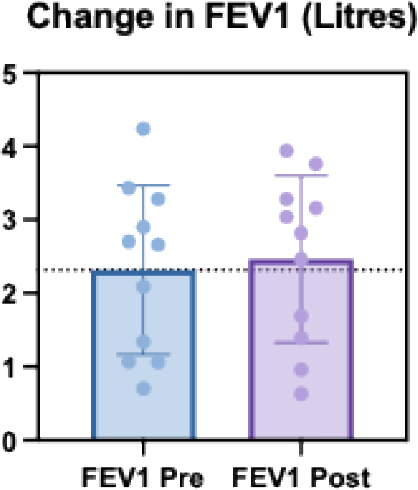
n=23; shows the change in FEV1 (in litres) after commencing dupilumab.
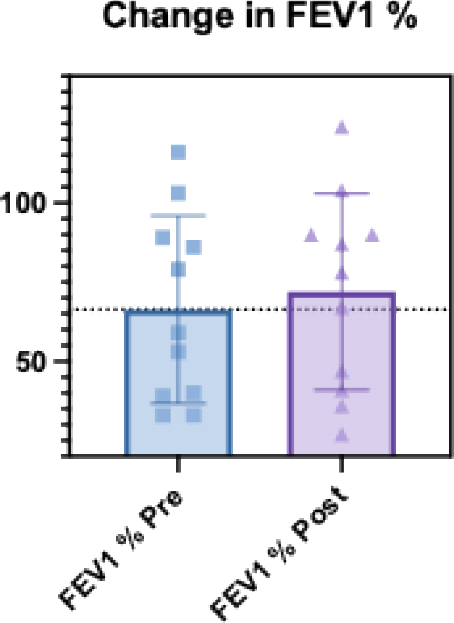
n=23; demonstrated change in FEV1 as a (%) after commencing dupilumab.
In those who had previously received biologic therapy, there was a mean reduction in the 6 months following in ACQ of -0.9 (2.6 pre to 1.8 post) and for those who were biologic naïve, there was a reduction in ACQ of -1.2 (2.4 pre to 1.3 post). In those who had previously received biologic therapy, there was a reduction in exacerbation frequency six months post-commencement of biologic therapy of -2.7, and -4.8 for those who were naïve. Biologic-naïve patients had numerically greater improvements; however, there was no statistically significant difference between them.
Five patients (12.8%) discontinued dupilumab. Two reverted to previous biologic therapy (benralizumab), and a further two have completely discontinued biologic therapy. One of the patients stopped dupilumab secondary to migraines. This patient has sought to subsequently restart dupilumab since ceasing therapy, as migraines have much improved, and their asthma was controlled while on dupilumab. This highlights the need for individualized treatment approaches and monitoring of patient-reported outcomes to guide ongoing therapy, particularly with the advent of multiple monoclonal antibodies for treatment. One patient developed oral cancer during the study period, which was unrelated to asthma management, and two patients remain on maintenance oral corticosteroids, reflecting the complexity of managing severe asthma in patients with overlapping comorbid conditions and refractory disease.
4. DISCUSSION
Overall, these findings support the real-world effectiveness of dupilumab in improving symptom control and reducing exacerbation frequency in patients with severe asthma, including those who have previously received other biologics. These findings are highly relevant given that dupilumab only became reimbursable in Ireland in late 2023, and data from Irish populations have been limited until now. Our study reflects the real-world clinical setting where patients with severe asthma may cycle through biologic therapies due to suboptimal response or tolerability issues and supports the positioning of dupilumab as a treatment option even in patients previously exposed to alternative biologics [8, 9].
The median age of 55 years (Interquartile Range (IQR) 43-63) aligns with the demographic typically seen in severe asthma clinics, indicating relevance to a late-middle-aged population where comorbidities may also influence treatment outcomes and persistence [10]. Dupilumab in this cohort, as with other studies, was generally well tolerated [11], with a discontinuation rate of 12.8% at six months. Adverse events were limited, with only one case of migraine being directly attributed to therapy. This is in keeping with previous data [5, 12]. Importantly, one patient sought to restart therapy after discontinuation, highlighting patient-perceived benefit and the need for shared decision-making in long-term management.
The lack of significant lung function improvement underscores the need for further investigation into predictors of FEV1 response and patient selection strategies to optimise treatment benefits [10]. FEV1 improved numerically; however, statistical significance was not achieved. There were a number of reasons why this may be the case; one is the relatively small subgroup, and another is that many in this cohort had previously received other biologics, which may have had a stabilising effect on lung function prior to switching therapy. This finding is also in keeping with other real-world studies [13, 14] that report clinically relevant but sometimes modest improvements in lung function.
Further, larger-scale real-world studies with longer follow-up may help to delineate the long-term benefits and safety of dupilumab, particularly in patients switching from other biologics due to inadequate response or tolerability issues. Biologic therapies have been demonstrated to reduce hospitalisation, particularly among those that target the IL-5 pathway [15-17]. However, our research is in line with other real-world data that dupilumab improves asthma control in those who had previously received that therapy [13, 14].In this real-world cohort, dupilumab significantly improved asthma control and reduced exacerbation frequency in patients with severe asthma, including those previously treated with other biologics, consistent with existing literature [18-21]. Exacerbation frequency was calculated by doubling the exacerbation frequency for the 6 months post-treatment in the cohort of patients after commencing treatment. Alternatively, this could also have been calculated by halving the exacerbations in the cohort for the 12 months prior to commencement of therapy. Using this method of calculation, there was a reduction in exacerbations from a mean of 2.4 to 0.5. No significant improvement in FEV1 was observed despite a positive trend, highlighting the need for further exploration of predictors of lung function response [22]. A proportion of patients discontinued therapy, emphasizing the importance of individualized management and monitoring.This study is limited by its single-centre and retrospective design. Nonetheless, the strength of this study lies in its real-world relevance, reflecting outcomes in routine clinical practice outside of trial conditions. It is a real-world clinical outcome for those patients switched to or commenced on dupilumab in a well-defined cohort, when there is a lack of head-to-head comparison data for biologic agents available to patients with severe asthma [10, 23, 24]. A key strength of this study is its inclusion of patients switching from other biologics. Approximately two-thirds of the cohort had previous biologic exposure, most commonly to anti–IL-5 therapies. Despite this, dupilumab still produced significant improvements in both symptom control and exacerbations, in keeping with other data [25]. At six months, 13/39 (33.3%) had an ACQ of <1.5, indicating control of the patient’s asthma. 9/39 (23%) of patients reported no exacerbations in the 6 months following commencement of treatment. These findings echo recent real-world evidence which supports dupilumab’s effectiveness in patients switching from anti- IL-5 therapies [13, 14].There is emerging evidence that the risk and severity of allergic disease may be influenced by modifiable environmental and pharmacological factors via air pollution and climate change. An increased risk of asthma, atopic dermatitis and sensitisation to food allergens in children has been associated with early life exposure to environmental antibiotics [26]. Capsazepine in pre-clinical models blocks the TRPV1 receptor, and there have been some reductions in airway hyperresponsiveness, inflammation and Th2 cytokine production, which highlights a further pathway that environmental irritants may be targeted therapeutically [27]. While these factors lie outside the direct scope of this cohort, they underscore the multifactorial nature of allergic airway disease, and may be of value for further consideration in future studies to examine biologic response alongside environmental and pharmacological modifiers [28].
CONCLUSION
In conclusion, in a single-centre academic university-affiliated specialist adult centre, dupilumab meaningfully improves asthma control and reduces exacerbations within six months in both biologic-naïve patients and those switching from other biologics. Lung-function gains may be modest at the group level in short-term follow-up, but this should not overshadow robust patient-centred benefits. These data support dupilumab as an effective, real-world option across common severe-asthma pathways and justify continued follow-up to 12 months to evaluate persistence, steroid-sparing, and longer-term lung-function trajectories.
AUTHOR’S CONTRIBUTION
The authors confirm contribution to the paper as follows: D.M.M., M.M.O’D.: Study conception and design; M.M.O’D., O.S.F.A.: Data collection; M.M.O’D., O.S.: Analysis and interpretation of results; M.M.O’D., D.M.M., K.F.D., H.I., B.J.P.: Draft manuscript; All authors reviewed the results and approved the final version of the manuscript.
LIST OF ABBREVIATIONS
| ACQ | = Asthma Control Questionnaire |
| FEV1 | = Forced expiratory volume |
| Anti IL-5 | = Anti Interleukin 5. |
| GINA | = Global Initiative for Asthma |
ETHICS APPROVAL AND CONSENT TO PARTICIPATE
This study had ethical approval from the Clinical Research Ethics Committee, University College Cork, Ireland (ECM 4 (e) 22/10/2024& ECM 3 (l) 19/11/2024).
HUMAN AND ANIMAL RIGHTS
No animals were used in this research. All procedures performed in studies involving human participants were in accordance with the ethical standards of the institutional and/or research committee and with the 1975 Declaration of Helsinki, as revised in 2013.
AVAILABILITY OF DATA AND MATERIAL
All the data and supporting material are available within the article.
ACKNOWLEDGEMENT
We would like to acknowledge E. J. for permission to use the ACQ score in this study.